01
Edition 3 withdrawn
Edition 3 was withdrawn on 30 September 2026. Edition 4 applies to every test from 1 October 2026.
Same tightness test, new way to judge it. Watch the 5 minute guide, then let the Tightness Test app time the test, read your U-gauge from a photo, work out the volume, the allowed drop and the purge, and write the record.


For Gas Safe registered engineers and their apprentices.
What changed
Edition 3 was withdrawn on 30 September 2026. Edition 4 applies to every test from 1 October 2026.
The allowed drop now depends on the installation volume (pipework, fittings and meter), not the meter size.
Appliances connected and a small drop? Isolate them and retest the pipework on its own.
The Tightness Test app
Take a photo at the start and the end. The app finds the level and reads it to the nearest 0.25 mbar; zoom in and correct it if you need to.
Pass, isolate-and-re-test or fail against the Edition 4 table, with the next job spelled out. Test 1, 2, 3 all on the record.
Pipe lengths, fittings and meter give the installation volume; purge volume 1.5 × IV and whether to purge to air or to ignition.
Reads the meter from a photo, times the minute, gives m³/h and the heat input gross and net.
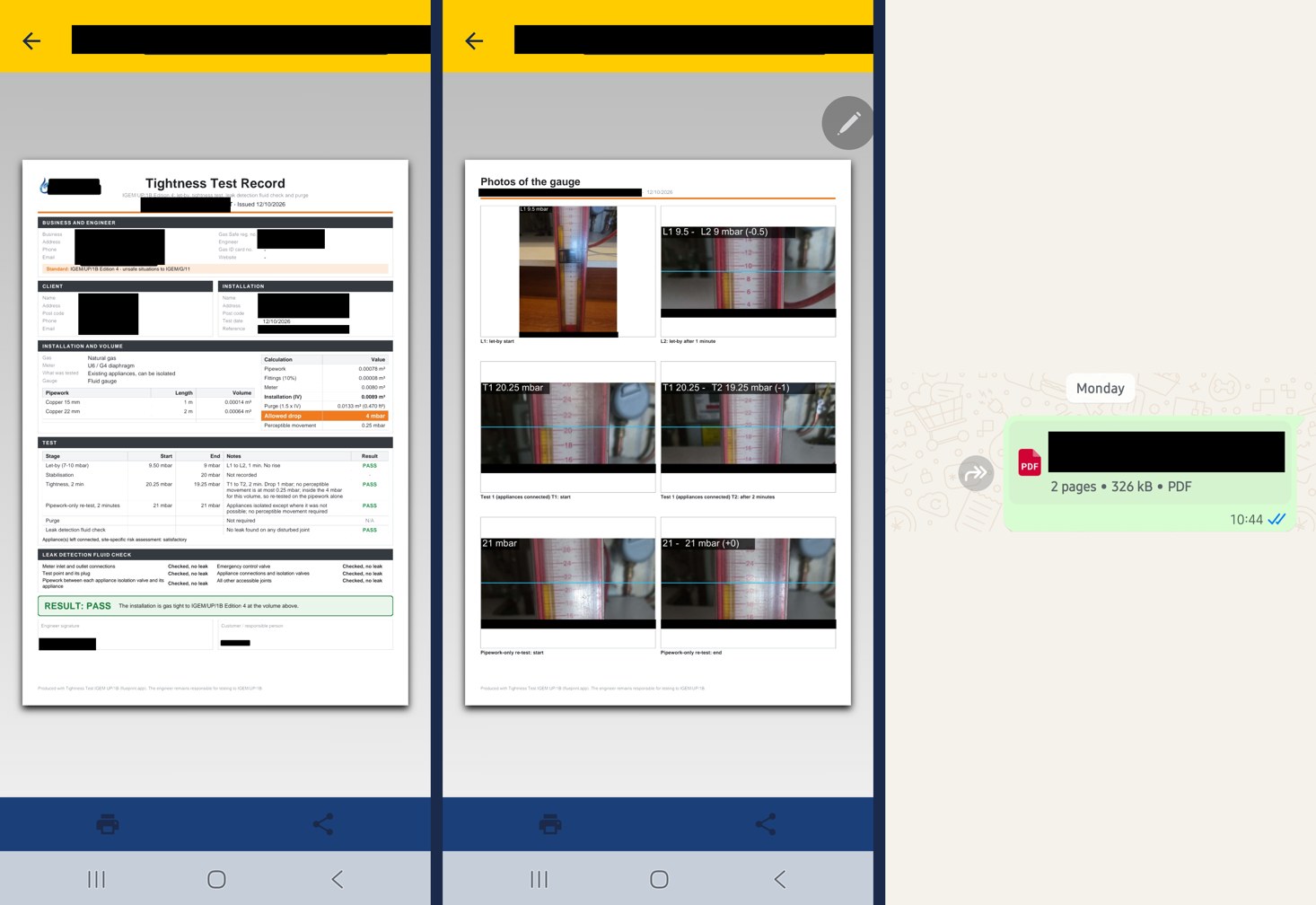
Let-by, every test, purge, leak detection fluid check and result on page one; your gauge photos on page two. Save the result on its own or issue the certificate.
A look inside
Scroll sideways. Screens from the app, test figures from a demo account.
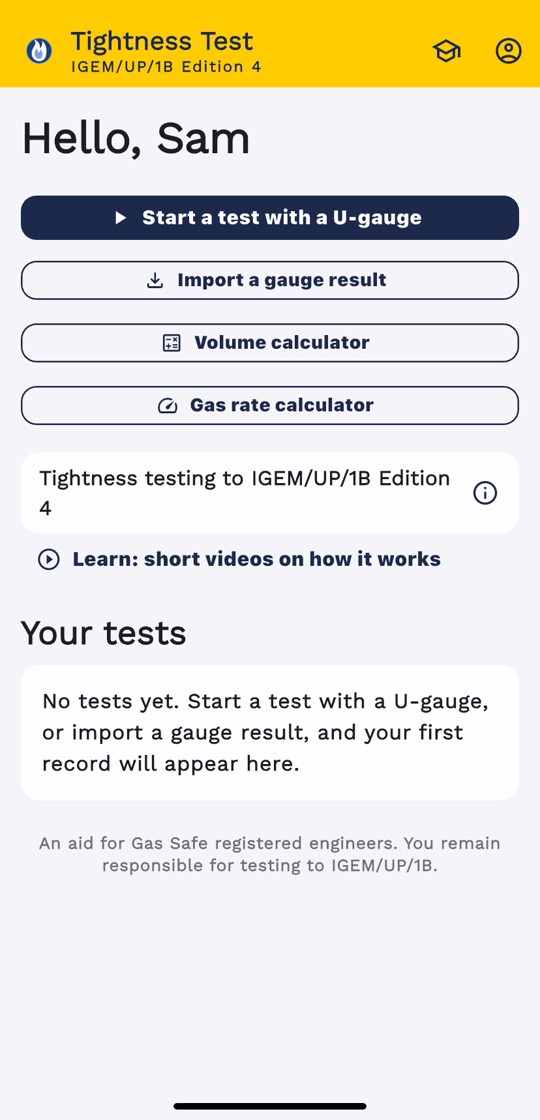
Home: start with a U-gauge, import a gauge result, or the calculators
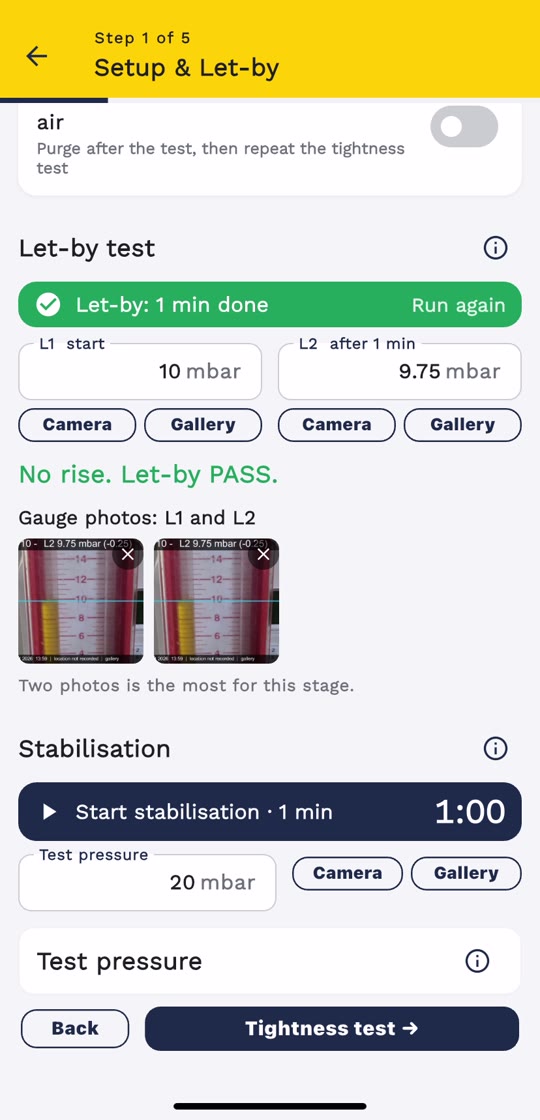
Setup and let-by: gauge photos, readings and the let-by verdict
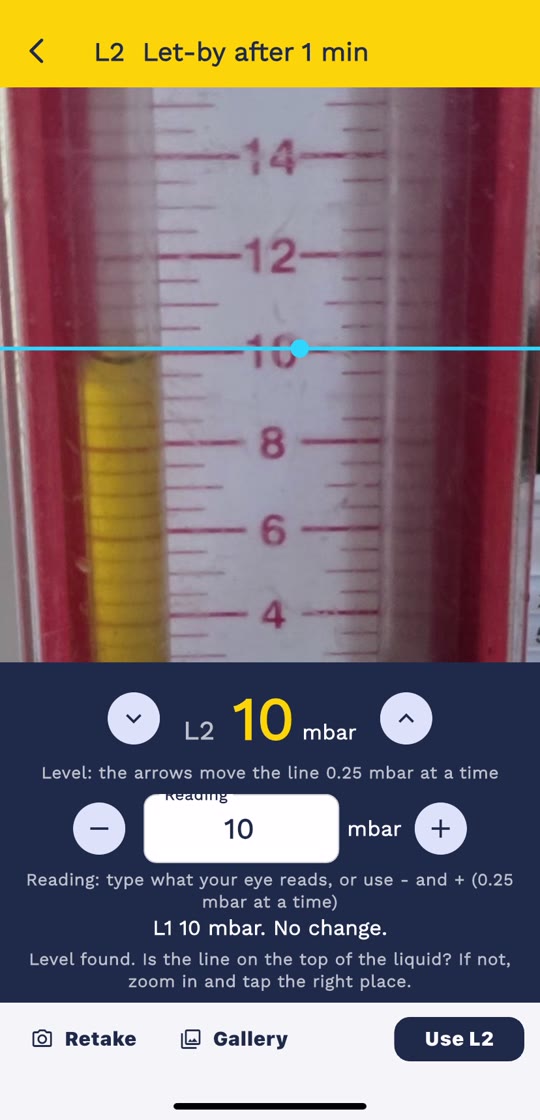
The reader finds the level on your photo. Disagree? Move the line or type the number
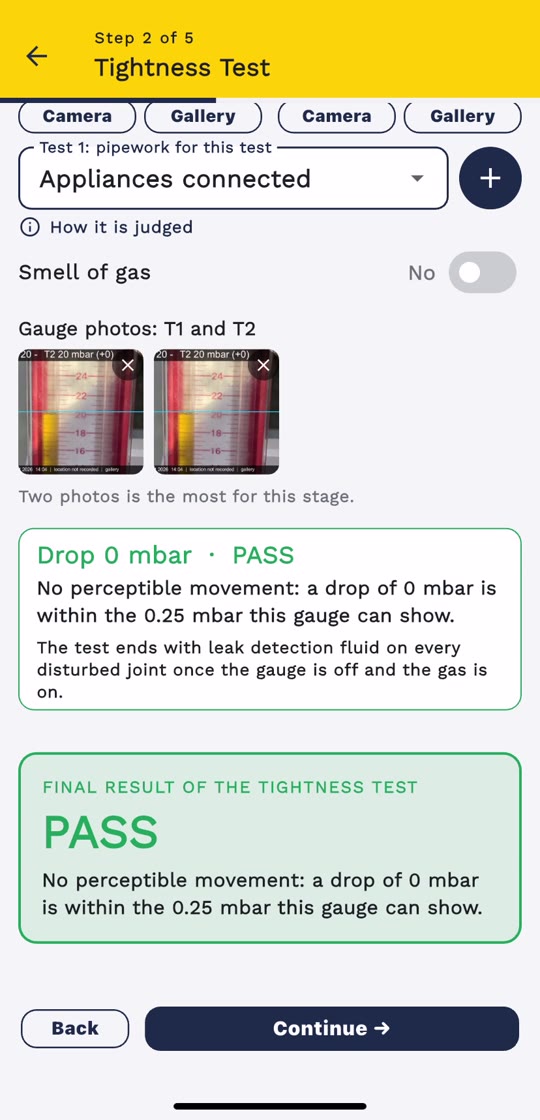
Tightness test: the verdict the moment the readings are in
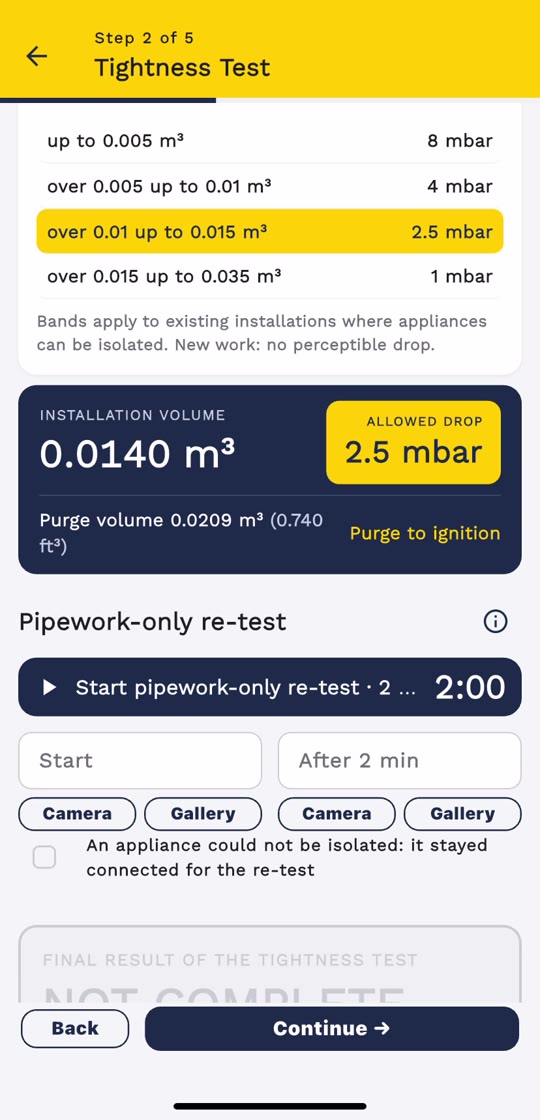
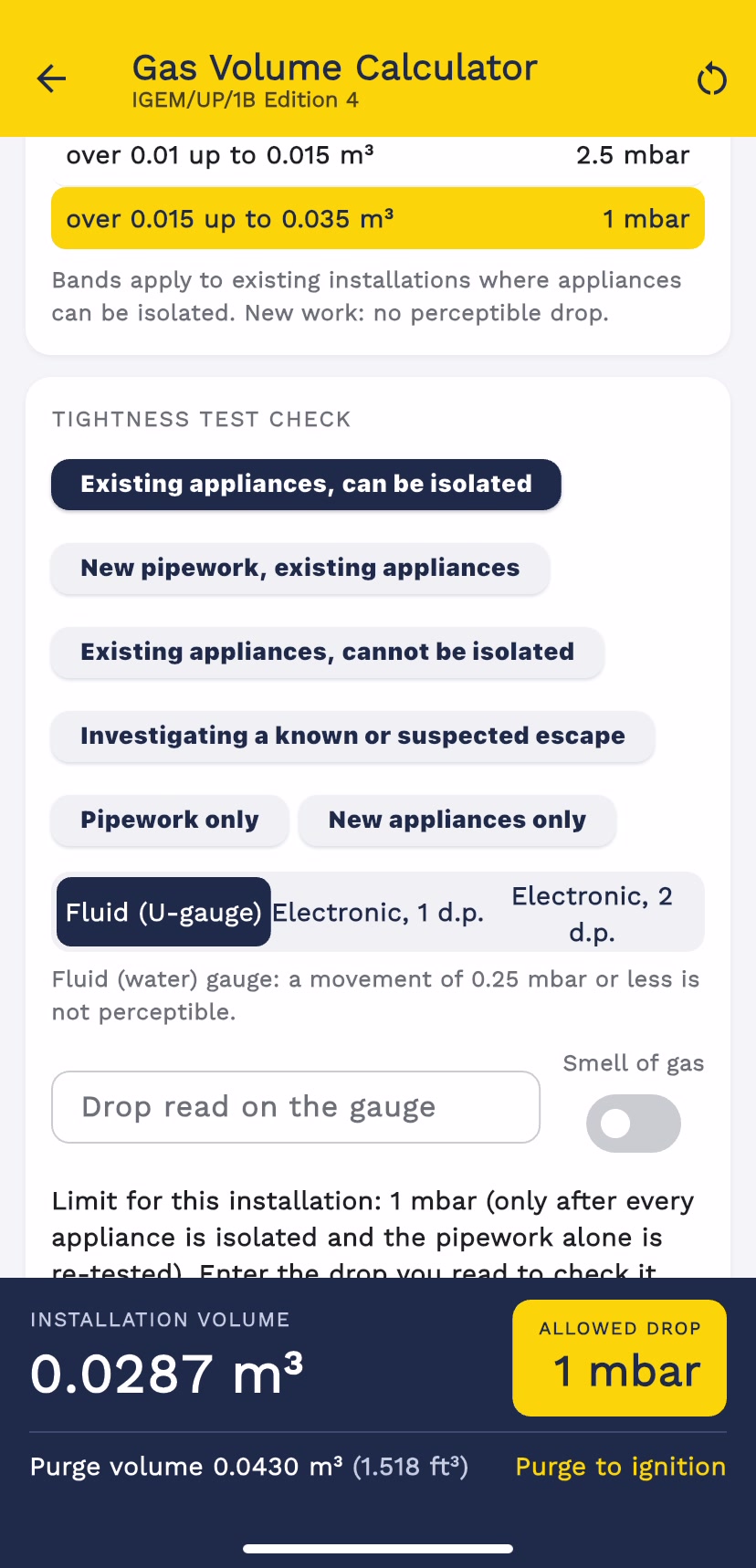
Installation volume, allowed drop and the pipework-only re-test
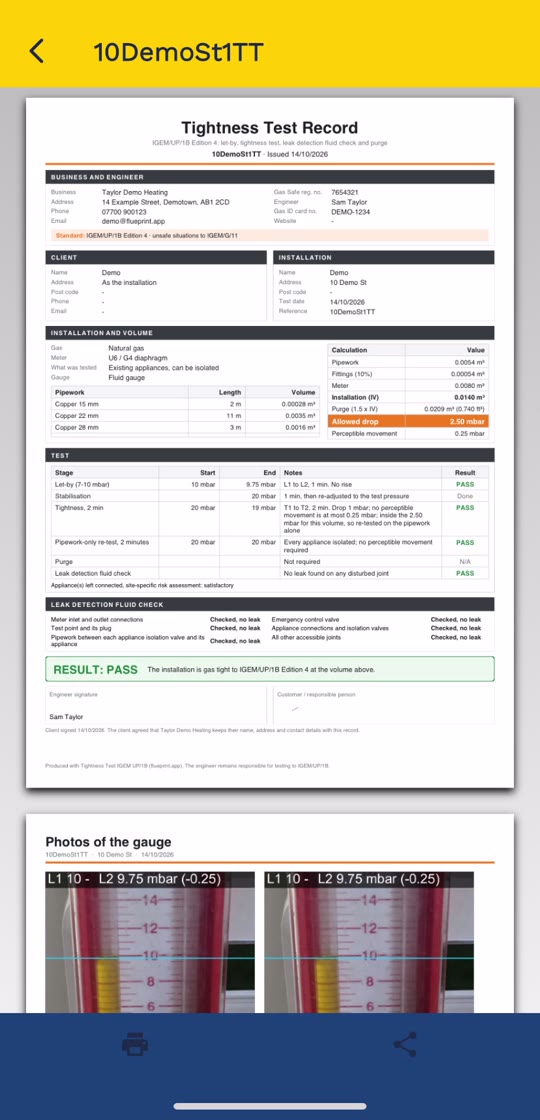
The record: every test and the result on page one
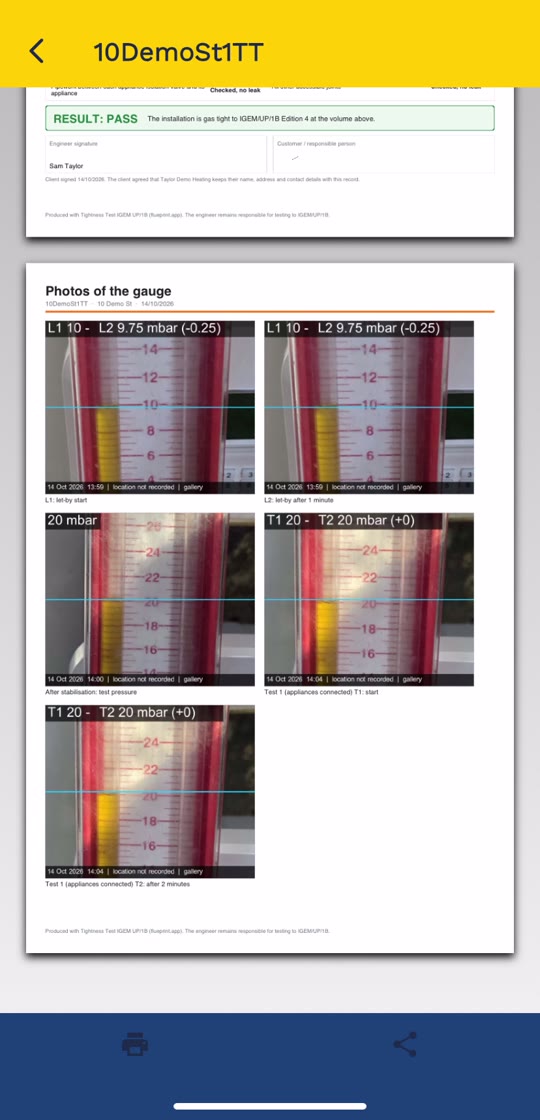
The record: your gauge photos on page two
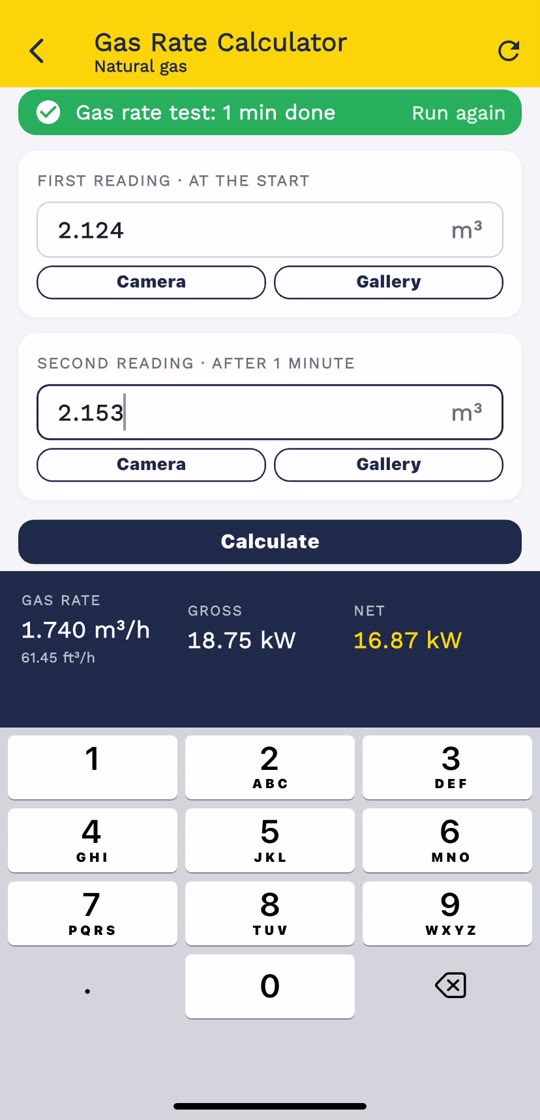
Gas rate calculator: m³/h and the heat input
The record
Page one has every test and the result. Page two has your gauge photos. Personal details are blacked out.
How it works
One video for the whole app, and one for each part. Soft spoken.
What changed in Edition 4, how the drop is judged by volume, existing appliances, the re-test and a worked example.
Choose how the gas is tested, photograph the gauge, and move the line or type the number if you disagree with the reading. Then the let-by timer.
Stabilisation, the two minute test, a 1 mbar drop, the installation volume and the pipework-only re-test, to the final pass.
Pipe lengths, fittings and meter give the installation volume and the purge volume.
Two meter readings a minute apart, typed or read from a photo or the camera: m³/h and the heat input.
Page one has every test and the result. Page two has your gauge photos with the readings drawn on.
A house with a combi boiler, gas fire and gas hob. The tightness test shows no drop, so it passes. Low-pressure natural gas.
Isolate the appliances and repeat the test on the pipework only.
An appliance that cannot be isolated stays connected, and no perceptible movement is allowed.
Trace and repair, or disconnect and make safe, then repeat the test. These videos are an aid to the standard. You, the engineer, are the decision maker.
Gas, what is being tested, let-by and stabilisation, each timed.
Two minutes. Photo the gauge or type it. The verdict shows at once; the volume only if the gauge moved.
Purge by volume, repeat test, LDF on every disturbed joint.
Who and where, with the client's signature on the phone.
PASS or FAIL against Edition 4. Save the result, or issue the certificate as a PDF.
Download the Tightness Test app and do your next test to Edition 4.
Coming soon on the App Store and Google Play.
Gas Safe registered engineers, and apprentices working under one at a registered business. New accounts need a Gas Safe business registration number, which is declared by you and may be checked against the Register.
Installations up to 0.035 m³, pipe up to 35 mm, meter up to 16 m³/h. Above that, IGEM/UP/1A.
No. It is an aid; you remain responsible for testing to the current IGEM/UP/1B.
Nothing to download or use at the moment. If that changes we will tell you first, and your records stay yours.
Last updated 7 October 2026 · hi@flueprint.app